Sunday, June 20, 2010

Analysis


To analyze the recorded data, I created the following diagram using a basic trigonometry formula:


This allowed me to get to find the treasure very quickly.


Actual Analysis Below:


*Please note, for analysis purposes productive tasks are defined as work related, reproductive tasks are defined as those concerning the family. On this chart, I have now highlighted in blue all productive time, with reproductive time in yellow, community managing in pink, and neutral time with no highlight. It is quite apparent that most of the time of all three subjects is spent on productive tasks.


Caviat: It should be noted that Subjects 2 and 3 do not have children, and only work on weekends. As such, the schedule recorded above is not fully representative of their activities, although they did say that majority of their week is utilized studying/working. As such, they are not representative of women who must work with children at home.

Subject 1, Patrizia is also a very interesting case. Her mother and that of her husband Andrei help out by taking care of their children. As such, Patrizia and Andrei are both freed up so to speak, to pursue productive tasks. Patrizia, as a woman with children, has very little recorded reproductive time. After sending her children off to school, she spends the vast majority of her day working long hours of productive time.


The comments of subjects 2 and 3 are quite interesting in terms of gender roles, and would seem to contradict each other, unless considered separately. Essentially they said that as far as fatigue goes it would be easier to be a man, but in terms of interaction with customers, it is better to be a woman. Perhaps we can observe, that if we accept their comments as fact, that both genders have their ups and downs in the food service industry, especially in rural Italy. However, their comment on men having better stamina than women in being able to handle work related fatigue is most likely untrue and very subjective.

The Case Study

For the case study I used the gold standard, a wind shield assessment:


In actuality, I used a daily schedule format to record the daily activities of Patrizia and two agriturismo restaurant staff. The results are below, with notes further down:

Subject 1 Important Notes: No work is done on Sunday, sometimes Saturday is a half-day. Family management is done in rotating weekly shifts by Patrizia’s mother and Andrei’s who come to live with them for each week. Andrei and Patrizia commented that phone communication plays a key role in coordinating all of these tasks.

Subject 2 and Subject 3 Important Notes: Subjects only work on weekends. During the week they work other jobs or attend school/study respectively. Kitchen work roles were noted as flexible. Both subjects live with their parents who work. Subject 2 takes care of housework and manages minor farm tasks like tending to animals while parents are at work. Both subjects stated that there is plenty of fatigue associated with their food service tasks, and commented that it would be easier to be a man to manage such fatigue.

That said, they outlined the following scenarios as typical service situations:

Male patrons are typically more kind to women, while women patrons remain silent.

Women to male staff are typically not as kind as they would be to women, or remain silent.


Introduction to the Case Study


Intro: The agriturismo brings in revenue in 3 different ways chiefly, through farm production, restaurant service, and hosting tourists in their two bedrooms.
Food is distributed in the restaurant, as mentioned above, but also in markets and at a storefront in Viterbo, and separately in Rome on a door to door basis through a company called Biobox.

As 80% of the world's agricultural providers are women, I thought it would be interesting to explore the role of women at Agriturismo Arvalia. I will analyze the restaurant component of their system using a gender lens and accompanied by a daily calendar tool.
Patrizia is on the right.


Patrizia's Role as the owner of the agriturismo is as follows:
She is responsible for procurement, food distribution, and maintaining the network with other farms in the area so they can respond to demand while keeping prices at a reasonable level.

There are 13 farm staff, 3 men and 10 women a relatively clearcut example of an agricultural system with mostly women workers. Some of the women have children of their own, having left their jobs to raise them, and then had difficulty returning to work. They found jobs at the agriturismo. Some of the female staff are relatively young, about 20 years old.

Andrei does not actually have a role on the farm. He is "staying there as a guest." The board of the Italian Organic Farmers' Association is composed of 2 men and 2 women.

Fun GMO Facts

Andrei also cited some interesting GMO facts:

Propagating GMO seeds cuts down on biodiversity as part of a seed control monopoly globally.
This limits farmer independence, but also cuts down on the variety of plant life, limiting our natural landscape and preventing the evolution of new and different species since all species of crops would eventually be the same.

110 million acres worldwide are using conventional farming techniques.
30 million acres worldwide are using organic farming techniques.

Organic Vs. Conventional Farming


Here are a few pictures of some of the crops!


Andrei also spoke about the difference between organic and what is titled "conventional" farming. Conventional farming. Before I explain Andrei's take, I'd like to explain the difference between the two terms.

Conventional farming uses technological advances including pesticides, herbicides, and non-organic fertilizers to harvest a larger amount of crops with a less degree of time and effort.

Organic farming relies almost solely on natural mechanisms to achieve a reasonable harvest.

Conventional farming is in fact not conventional at all. The definition of conventional is conforming or adhering to accepted standards, as of conduct or taste. Yet these accepted standards of including antibiotics, steroids, hormones, chemicals, and other additives in food production have only existed in the Post World War II era. Prior to World War II, all food was largely organic (making organic the conventional method of food production) for 25,000 years.
Organic is conventional, while conventional food production is simply unhealthy.

Andrei explained that the conventional farming process is much too reliant on oil, and not sustainable over the long haul. In particular, oil is heavily involved in the production of pesticides and in-organic fertilizers.


The Need for Agriturismos


Patrizia and her husband are agronomists. Patrizia is the owner and proprietor of Agriturismo Arvalia, a magnificent haven for those with a refined pallet. Vegetables and produce of the most delicious variety can be found in abundance. Patrizia's husband Andrei is the current leader of the Italian Organic Farmer's Association.

While visiting the Agriturismo, Andrei was kind enough to explain to myself and company about the current food policy conditions worldwide. This laid the foundation for understanding the need for more fully organic farms within Italy and the world, and more agriturismos. What follows is some of the background information he gave us.

Andrei is the gentleman on the left.*

Following World War II, there was a major paradigm shift in the way many countries, especially in Africa acquired their food. Countries that had been dependent on various staple foods, now became dependent on foods like broken rice that were being imported to their countries by the international community. This led to a drastic overhaul as farmers shifted their production to accommodate the market presence of these goods, leading countries to dependency on this international market.

La Via Campecina was founded in 1992 to bring together farmers from local and medium size producers, indigenous communities, rural women, and agricultural workers the world over, but those south of the equator in particular, according to Andrei. This group of 148 organizations coined the term "food sovereignty," the right to produce food in one's own territory, a direct contrast with reliance on international markets. In this way, farmers and those most associated with agriculture could band together and fight for their right to produce and eat their own food!
With 1.4 billion farmers/peasants worldwide, having a representative organization really means something.


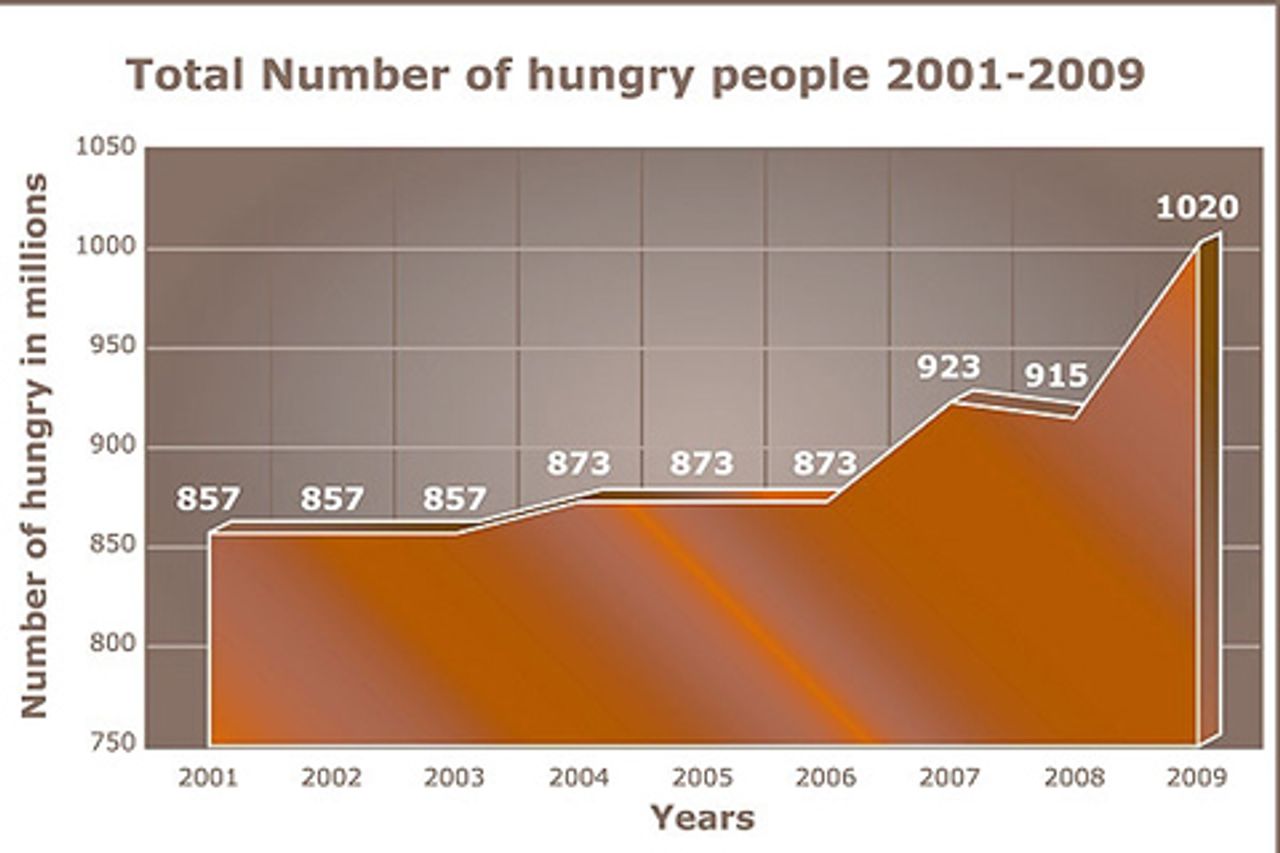
In 1996, the Millennium Development Goals were created, among them to halve the number of hungry people worldwide by 2015. Instead, this number has only increased through 2010 to over one billion people. Although, many UN member nations agreed to adopt the MDGs, less heads of state attended the World Food Summit in 2002, following failed progress at achieving this goal. Previously, climate change and emissions had been the chief issues on the table, but now hunger was coming to the fore, especially in terms of increasing agricultural production worldwide.

As a note:
Funding for Farming Subsidies Worldwide:
45 Billion Euro to subsidize European farming

20 Billion Dollars to subsidize farming in the U.S.

1 Billion allocated by the International Monetary Fund to subsidize farming in the rest of the world

*Please note, all photos in Posts 1-6 are courtesy of Dwight.